
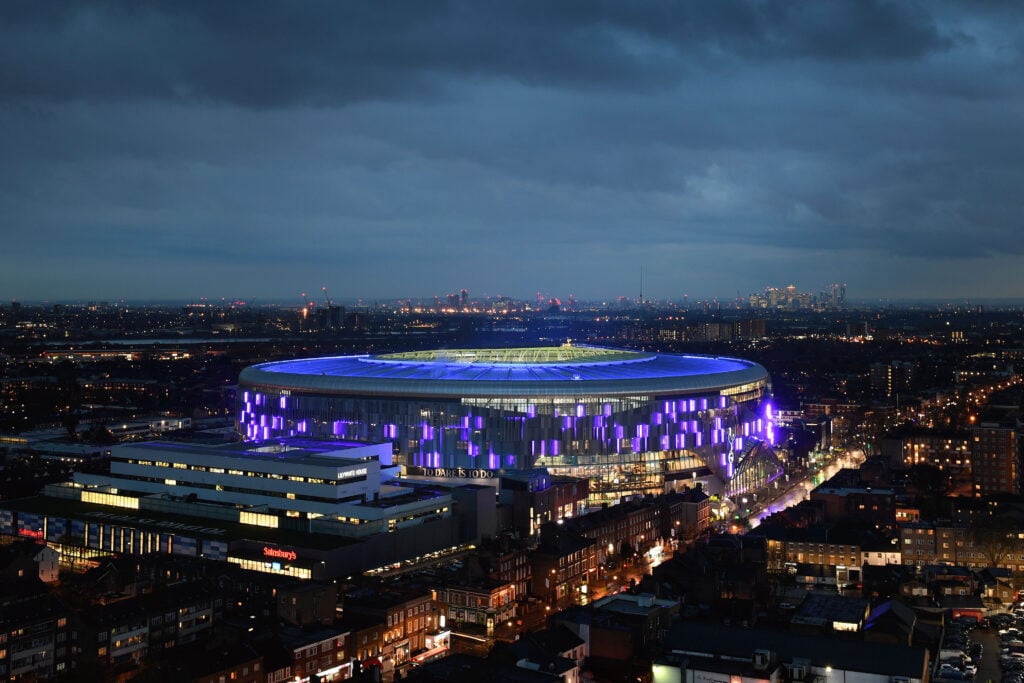
Tottenham Hotspur Stadium has been the home of Tottenham Hotspur since April 2019.
Built on the same site in N17 that Tottenham have called home since 1899, the stadium replaced White Hart Lane and has a capacity of 62,850.
It is currently the largest club football stadium in London and was designed as a multi-purpose venue capable of hosting Premier League football alongside NFL games, concerts, boxing, rugby and other major events.
The stadium also features a retractable grass football pitch, a separate artificial playing surface underneath, a 17,500-seat single-tier South Stand and more than 60 food and drink outlets.
This guide covers the stadium’s capacity, opening, construction, history, location, transport options, facilities and its connection to the old White Hart Lane.
Information checked: 16 September 2026.
Tottenham Hotspur Stadium information
| Stadium name | Tottenham Hotspur Stadium |
| Club | Tottenham Hotspur |
| Location | Tottenham, north London |
| Opened | April 2019 |
| Capacity | 62,850 |
| First men’s competitive match | Tottenham 2-0 Crystal Palace, 3 April 2019 |
| First competitive goalscorer | Son Heung-min |
| South Stand capacity | 17,500 |
| Previous stadium | White Hart Lane |
| Address | 782 High Road, London, N17 0BX |
For wider information about Spurs, see our Tottenham Hotspur club information guide.
What is Tottenham Hotspur’s stadium called?
Tottenham’s home ground is officially called Tottenham Hotspur Stadium.
The venue has operated under that name since opening in 2019.
Tottenham has explored the commercial opportunity of stadium naming rights since plans for the new ground were being developed, but the venue continues to use the Tottenham Hotspur Stadium name.
It should not be referred to as White Hart Lane when describing the current stadium, although the new ground occupies the same historic N17 site and many supporters naturally retain a strong connection with the old stadium.
What is the capacity of Tottenham Hotspur Stadium?
Tottenham Hotspur Stadium has an official capacity of 62,850.
Tottenham describes it as the largest club stadium in London.
A major feature of the ground is the South Stand, which contains 17,500 seats in a single tier.
The stand rises more than 34 metres and is topped by Tottenham’s famous golden cockerel.
The stadium was designed to create a close relationship between the pitch and supporters. Tottenham states that distances between the front row and touchline range from approximately 4.9 metres to 7.9 metres.
When did Tottenham Hotspur Stadium open?
Tottenham Hotspur Stadium officially opened in April 2019.
The first senior competitive match took place on 3 April 2019 when Tottenham faced Crystal Palace in the Premier League.
Spurs won 2-0.
Son Heung-min scored the first senior competitive goal at the new stadium in the 55th minute, before Christian Eriksen added the second.
The match marked Tottenham’s return to N17 after playing home fixtures at Wembley Stadium while construction of the new ground was completed.
The opening represented one of the biggest changes in the modern history of Tottenham Hotspur.
When was Tottenham Hotspur Stadium built?
The development of Tottenham’s new stadium took place in phases and began while White Hart Lane was still being used.
That distinction is important because the current stadium was not simply constructed after White Hart Lane had already been demolished.
Work on the wider Northumberland Development Project and new stadium was underway alongside the old ground.
During the final 2016/17 season at White Hart Lane, part of the north-east corner of the old stadium had already been removed to allow work on the new development to continue.
Tottenham played the final match at White Hart Lane on 14 May 2017.
The following day, the club formally handed the old stadium over to construction contractor Mace and a 12-week deconstruction programme began.
By 31 July 2017, the last visually recognisable part of White Hart Lane had been removed.
Construction of the remaining sections of the new stadium then continued across the old footprint.
Tottenham played all of their home matches at Wembley during the 2017/18 season and remained there for much of 2018/19 before finally returning to N17 in April 2019.
Why did Tottenham replace White Hart Lane?
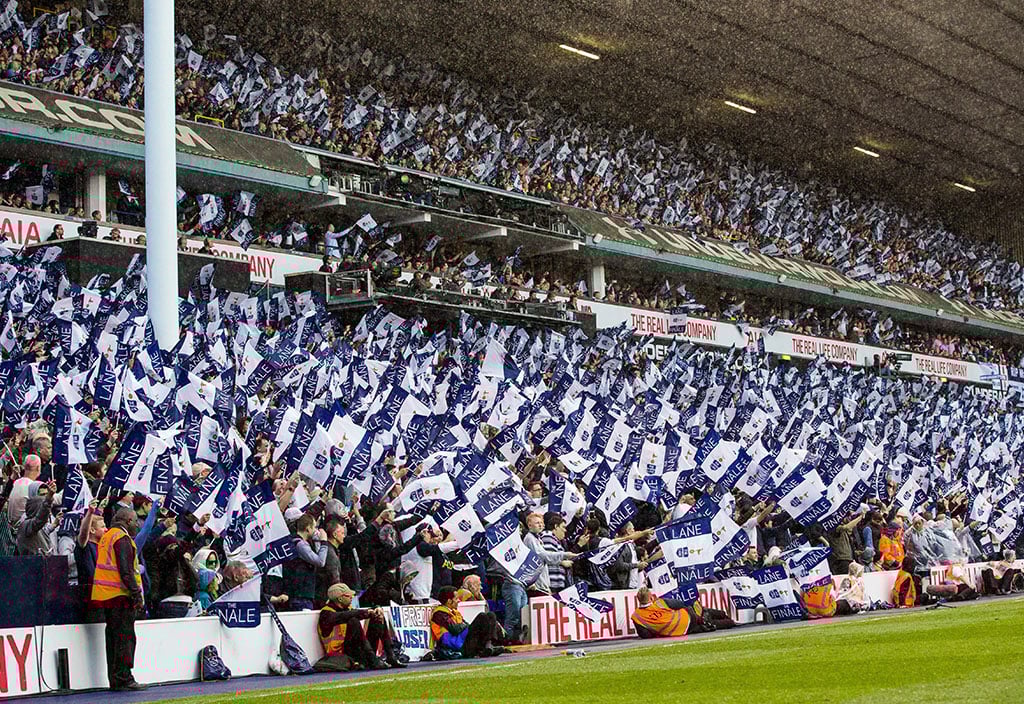
White Hart Lane had been Tottenham’s home since 1899 and was one of English football’s most recognisable grounds.
However, its relatively limited capacity and the physical restrictions of the site made significant expansion increasingly difficult.
White Hart Lane’s capacity reached 36,310 following seating changes in 2006, although this was reduced to around 32,000 during its final season as construction work for the new stadium progressed alongside it.
The new stadium allowed Tottenham to increase matchday capacity significantly while remaining on essentially the same historic site.
It also enabled the club to create a much larger commercial operation through hospitality, food and drink, visitor attractions and non-football events.
History of White Hart Lane
Tottenham moved to the site that became known as White Hart Lane in 1899.
The land had previously been used as a nursery and was located close to the White Hart public house on Tottenham High Road.
The first official match at the new ground took place on 4 September 1899.
Tottenham defeated Notts County 4-1 in a friendly watched by approximately 5,000 people.
Five days later, Spurs played the first competitive match at the ground, beating Queens Park Rangers 1-0 in the Southern League.
White Hart Lane subsequently became Tottenham’s home for 118 years.
During that period it staged many of the defining moments in Tottenham’s history, including league championships, FA Cup campaigns and famous European nights.
The ground underwent repeated redevelopment during its lifetime, eventually becoming an all-seater stadium.
Its final match took place against Manchester United on 14 May 2017.
Victor Wanyama and Harry Kane scored as Tottenham won 2-1 and completed their final league season at White Hart Lane unbeaten at home.
Kane therefore became the final Tottenham player to score at the old stadium.
The following day, deconstruction began.
For more about the trophies won during Tottenham’s years at White Hart Lane, see our complete Tottenham Hotspur honours list.
Did Tottenham play at Wembley?
Yes.
Tottenham used Wembley Stadium as a temporary home while the new stadium was being completed.
Spurs played all of their home fixtures at Wembley during the 2017/18 season.
The club had initially hoped to move into its new stadium earlier in the following campaign, but Wembley continued to host Tottenham home matches during much of the 2018/19 season.
The move back to Tottenham finally took place in April 2019.
How does Tottenham’s retractable pitch work?
One of the defining features of Tottenham Hotspur Stadium is its retractable grass football pitch.
The natural grass surface is divided into three pitch-length sections.
When it is retracted, the three sections slide beneath the South Stand.
This reveals a separate artificial playing surface underneath.
The arrangement allows Tottenham matches to be played on a dedicated natural grass surface while NFL games and many other events can use a separate pitch.
Each of the three retractable pitch sections weighs more than 3,000 tonnes.
The system was designed so the grass surface can be moved out of the stadium bowl without the joins being apparent when it returns to football position.
Tottenham has stated that the movement of the grass surface itself takes approximately 25 minutes, before the additional work required to transform the stadium for the relevant event.
Why does Tottenham Hotspur Stadium have an NFL pitch?
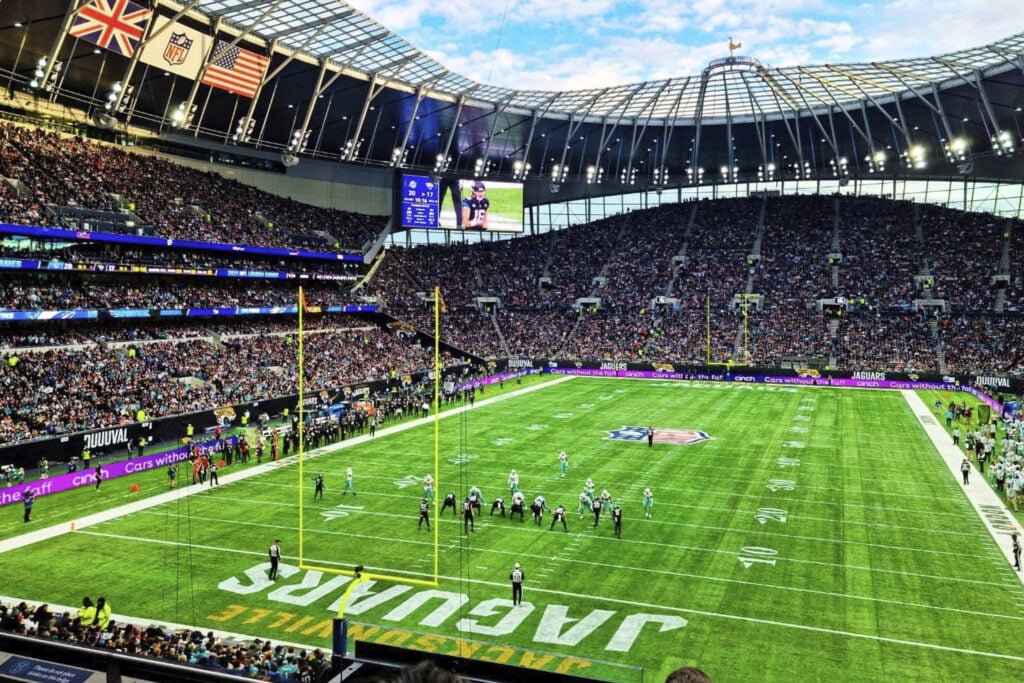
The stadium was specifically designed to accommodate both association football and American football.
Tottenham and the NFL announced a long-term partnership during the stadium’s development, with the venue designed to stage a minimum of two NFL games per year.
The artificial surface beneath the retractable grass pitch gives NFL games their own permanent playing surface rather than requiring the football pitch to be repeatedly converted.
The stadium also contains purpose-built NFL facilities, including dedicated locker rooms and player areas.
This design has allowed the venue to establish itself as the NFL’s permanent home in the UK outside the United States.
What else is held at Tottenham Hotspur Stadium?
Tottenham Hotspur Stadium was designed as a multi-purpose sports and entertainment venue rather than being used exclusively for football.
In addition to Tottenham matches, the stadium has hosted:
- NFL games
- Boxing
- Rugby
- Major concerts
- Corporate and private events
- Other sporting and entertainment events
The retractable pitch system allows the natural football surface to be protected while many non-football events take place.
Tottenham has said that revenue generated by major stadium events provides recurring commercial income that can be reinvested into the club’s football activities.
What facilities are inside Tottenham Hotspur Stadium?
The stadium contains more than 60 food and drink outlets across its concourses.
One of its best-known features is The Goal Line in the South Stand, which Tottenham describes as Europe’s longest bar.
The wider Market Place area forms part of the South Stand and offers a range of food and drink options.
The stadium also contains extensive hospitality areas, premium seating, media facilities, dressing rooms and specialist areas designed for both football and NFL events.
Some parts of White Hart Lane were also incorporated symbolically into the new stadium.
For example, crushed aggregate from the old ground was used within polished concrete flooring, helping maintain a physical connection between the two venues.
Where is Tottenham Hotspur Stadium?
Tottenham Hotspur Stadium is located on Tottenham High Road in north London.
The address is:
Tottenham Hotspur Stadium
782 High Road
London
N17 0BX
The stadium stands on the same historic site in Tottenham where the club has played since moving there in 1899.
Tottenham’s training base is located separately in Enfield.
You can find more information about that facility in our Tottenham Hotspur training ground guide.
How do you get to Tottenham Hotspur Stadium?
Public transport is generally the recommended way to travel to Tottenham Hotspur Stadium.
The four main rail and Underground/Overground stations used by supporters are:
White Hart Lane — London Overground
Northumberland Park — Greater Anglia
Tottenham Hale — Victoria line and Greater Anglia
Seven Sisters — Victoria line and London Overground
White Hart Lane is the closest railway station and is approximately a five-minute walk from the stadium.
Northumberland Park is approximately a 15-minute walk.
Matchday travel arrangements, road restrictions and rail services can change, so supporters should check current information before travelling.
Our dedicated guide explains how to get to Tottenham Hotspur Stadium in more detail.
Is there parking at Tottenham Hotspur Stadium?
Parking immediately around Tottenham Hotspur Stadium is heavily restricted on matchdays and major event days.
The stadium is located in a densely populated residential area and controlled parking zones operate around the venue.
Public transport is therefore generally the best option for supporters attending matches.
Accessible transport and parking arrangements are available for eligible supporters, but these can depend on the event and should be arranged using Tottenham’s current official guidance.
Can you tour Tottenham Hotspur Stadium?
Yes.
Tottenham operates stadium tours that provide behind-the-scenes access to areas not normally available to supporters.
Depending on the tour selected and operational requirements, visitors can see areas such as the dressing rooms, pitchside, media facilities and dedicated NFL areas.
Tottenham also offers specialist tour options at different times, including matchday, technical and legends experiences.
Because availability and prices can change, supporters should check Tottenham’s official stadium attractions before booking.
What is the Dare Skywalk?
The Dare Skywalk is a visitor attraction built into Tottenham Hotspur Stadium.
Visitors climb onto the stadium roof and reach the glass viewing platform around the famous golden cockerel.
The summit is approximately 46.8 metres above pitch level and provides views across the stadium and London.
An additional Edge experience allows visitors to complete a controlled descent from the stadium roof.
Availability, age and participation requirements should be checked with Tottenham before booking.
What is F1 DRIVE at Tottenham Hotspur Stadium?
F1 DRIVE – London is an indoor karting attraction located beneath the South Stand.
It uses electric karts inspired by Formula 1 technology and features multiple track configurations.
The location was made possible partly by the engineering space created for the stadium’s retractable pitch system.
The main Super Circuit is approximately 500 metres long and contains 17 turns and two DRS zones.
F1 DRIVE is a permanent visitor attraction at the stadium rather than a temporary race event.
Do Tottenham Hotspur Women play at the stadium?
Yes.
Tottenham Hotspur Women play selected home fixtures at Tottenham Hotspur Stadium.
Their regular home venue is Brisbane Road, but larger fixtures are periodically moved to the main stadium in N17.
The first Women’s Super League north London derby held at Tottenham Hotspur Stadium took place against Arsenal in November 2019 and attracted 38,262 supporters, which was a WSL attendance record at the time.
For the current squad, captain, manager and home-ground information, see our Tottenham Hotspur Women guide.
Why is the South Stand important?
The South Stand is one of the stadium’s defining architectural features.
It contains 17,500 seats in a single tier, making it the largest single-tier stand in the UK according to Tottenham.
Its design was intended to create a large concentration of home supporters behind one goal and contribute to the atmosphere inside the stadium.
The stand rises more than 34 metres and is topped by the golden cockerel that has long been associated with Tottenham Hotspur.
The retractable grass pitch also moves beneath the South Stand when the stadium is converted for NFL and other events.
Is Tottenham Hotspur Stadium on the same site as White Hart Lane?
Yes.
The current stadium occupies the same wider N17 site as White Hart Lane.
However, it is a completely new stadium rather than simply a redevelopment or expansion of the old ground.
Construction was carried out in phases because part of the new stadium was built alongside White Hart Lane while Tottenham continued playing there.
Once White Hart Lane closed in May 2017, the old ground was demolished and construction could continue across the remaining part of the site.
This allowed Tottenham to remain in the same part of north London that had been the club’s home since 1899.
Tottenham Hotspur Stadium facts
| Opened | April 2019 |
| Capacity | 62,850 |
| Location | Tottenham, north London |
| Address | 782 High Road, London, N17 0BX |
| Previous ground | White Hart Lane |
| White Hart Lane opened | 1899 |
| White Hart Lane final match | 14 May 2017 |
| First competitive stadium match | Tottenham 2-0 Crystal Palace |
| First competitive goalscorer | Son Heung-min |
| South Stand capacity | 17,500 |
| Food and drink outlets | More than 60 |
| Football surface | Retractable natural grass pitch |
| Alternative surface | Artificial pitch beneath the grass surface |
| Main additional sports use | NFL, boxing and rugby |
| Visitor attractions | Stadium Tours, Dare Skywalk and F1 DRIVE – London |
Tottenham Hotspur Stadium in summary
Tottenham Hotspur Stadium opened in April 2019 and has a capacity of 62,850.
It stands on the same historic N17 site where Tottenham first established their home in 1899, replacing White Hart Lane after 118 years.
The development was constructed in phases, with work on the new stadium taking place while White Hart Lane was still in use before the old ground was finally demolished in 2017.
Tottenham temporarily moved their home fixtures to Wembley before returning to north London for the first competitive match at the new stadium against Crystal Palace on 3 April 2019.
The stadium combines a 17,500-seat single-tier South Stand with a retractable grass pitch and a separate artificial surface, allowing the venue to host Tottenham matches as well as NFL games, concerts and other major sporting events.
For more information about the club, explore our Tottenham Hotspur club information, history of Tottenham Hotspur and Hotspur Way training ground guide.
Sources
Stadium capacity, design and facility information has been checked against Tottenham Hotspur’s official stadium guide.
Historical information about the club’s former ground has been checked against Tottenham’s official history of White Hart Lane.
Current travel and accessibility information is available through Tottenham’s official stadium transport guidance.