



Tottenham Hotspur’s pre-season success continued with a win in a surprisingly competitive friendly against Chelsea FC in Sydney, which gives us yet another chance to deduce the tactical state of play at Spurs under Roberto De Zerbi.
Friendly or not, it’s always a treat to beat a local rival.
Despite the sterile setting of an overseas ground, there was plenty of needle between the two London sides meeting in the heart of Sydney.
The game’s Premier League pedigree clearly lent itself to the players, with Conor Gallagher (and others) making sure to leave something extra in every challenge made on his ex-teammates.
The game’s intensity is probably the closest we’ll get to a competitive game for Tottenham this pre-season, which gives us the perfect opportunity to once again take a closer look at the team’s performance and tactics ahead of the season’s opening game in two weeks’ time.

Progress for Tottenham, but will it be enough?
It is beyond a shadow of a doubt that, as a team, Tottenham are reaching some of their highest levels since the departure of Ange Postecoglou and then some.
For the first time in more than a year, the team clearly has a tactical identity built around a coherent philosophy of a competent manager. Unlike during the early stages of the Thomas Frank reign, who needed the individual attacking brilliance of Mohammed Kudus to score goals, Roberto De Zerbi’s Spurs actually win their matches despite a desperately underpowered attack.
Even against a top Premier League side under an elite manager in Xabi Alonso, Spurs were able to rely on patterns of play coached by Roberto De Zerbi to get out of their own half and create dangerous chances.
Although the second-half red card for Kevin Danso changed the complexion of the game, pushing Spurs deeper and forcing them to rely on transitional moments, the in-possession approach in the first half allowed Spurs to largely control the proceedings.
How Spurs found a way to play through Chelsea
Spurs were usually trying to play out from a situational back three formed from the two centre-backs and the goalkeeper Kinsky.
Chelsea defended using a zonal system to defend their box but would step out in a more aggressive man-to-man press when Spurs were trying to play out.
With Essugo and Lavia tasked with marking Spurs’ double pivot, Tonali and Bergvall, Chelsea wanted to deny Spurs passing lanes into the midfield.
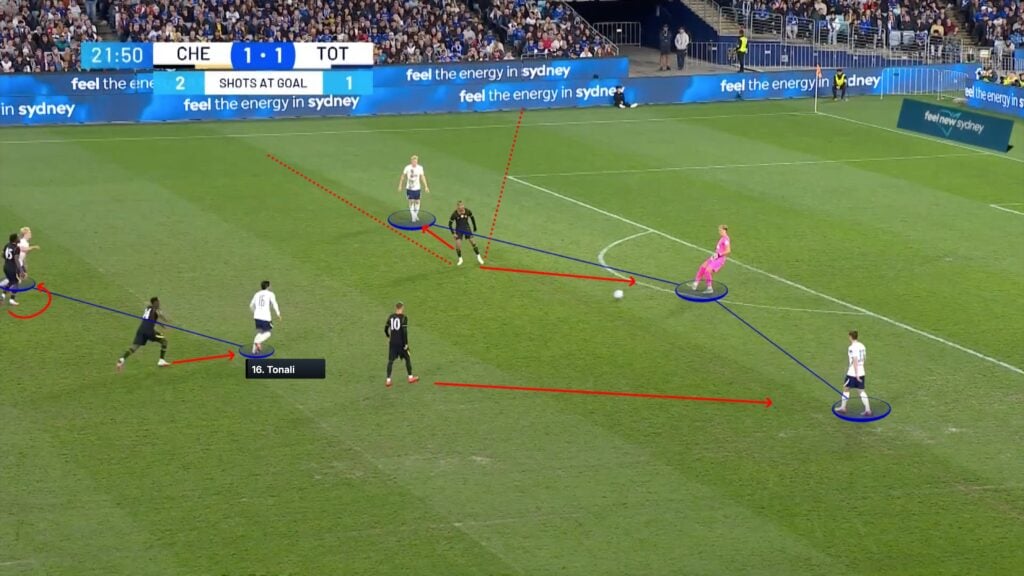
But throughout the first half Spurs would continuously rotate their midfield, sometimes shifting from a double pivot into a single pivot with either Tonali or Bergvall pushing up, and other times using Archie Gray (marked by Gittens) to drop in from his fullback role into midfield to further confuse Chelsea’s press.
This created openings to exploit and manipulate Chelsea’s disjointed and low-intensity press to progress the ball in dangerous ways.
Here, with Spurs recycling possession back to Kinsky, we see Essugo marking Tonali and Gittens picking up Bergvall, and Joao Pedro and Palmer on their way to pressure the two centre-backs.
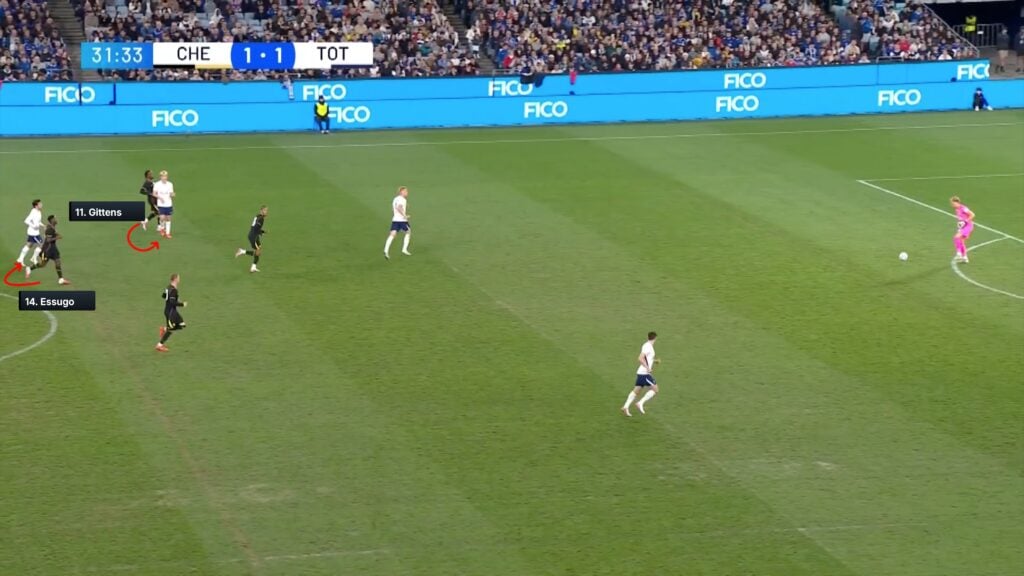
But Chelsea were slow to step out of their zonal block, and while Gittens steps back to cover the returning Archie Gray, Lavia doesn’t pick up Bergvall on time.
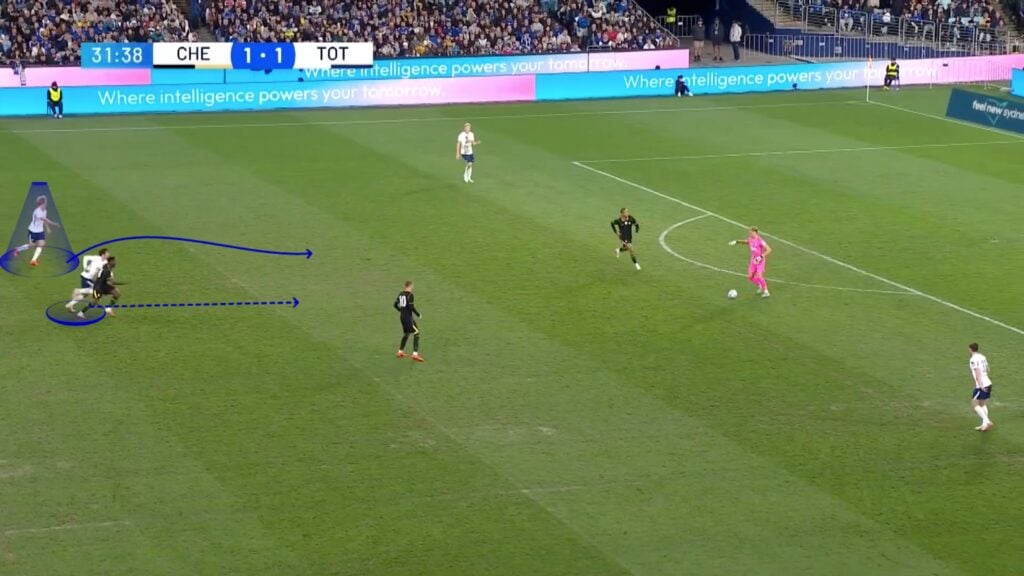
So when Tonali makes a decoy run, taking his marker, Bergvall finds himself completely free, allowing Tottenham to play out of the press and launch an attack.
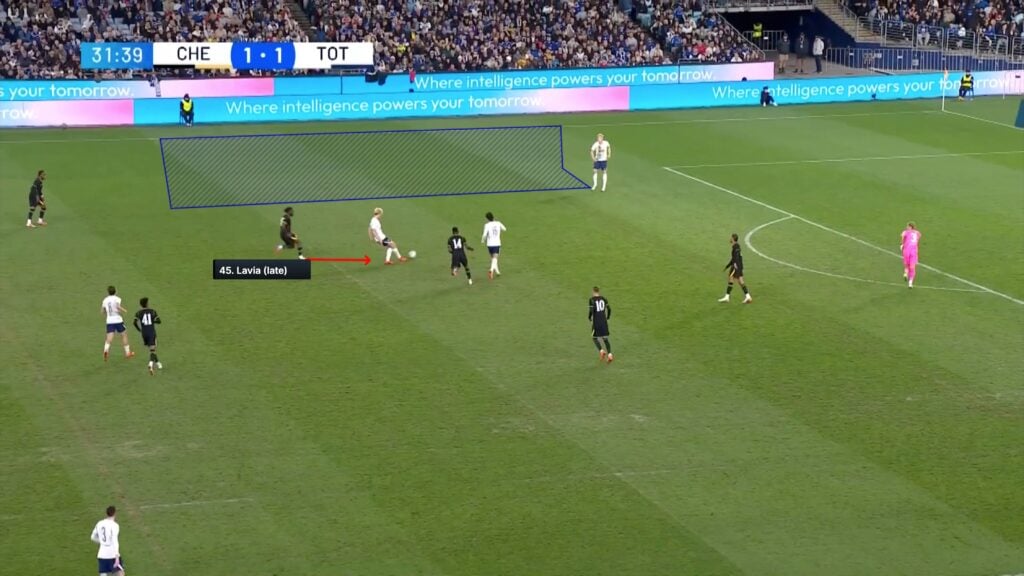
Spurs were able to find these kinds of third-man solutions quite consistently in the first half. And while their attacks often got stuck further up the pitch due to a bad touch or a poor cross or take-on from their attackers, the fact that Spurs are able to get into attacking positions in the first place is a promising sign.
Even without their most competent technical profiles in James Maddison or Mateus Fernandes, Spurs have shown plenty of attacking intent, setting up the occasion when we finally see Tottenham’s starting XI as a real treat.
Of course, the red card awarded to Kevin Danso for a silly defensive slip-up put the onus back on Chelsea and forced Tottenham into a defensive shape.
While they still kept some of their attacking intent, it became a game much more focused on individual performances, discipline and counterattacks, with less to be extracted about Spurs’ tactical intentions.
But, in the late goal from Richarlison, as well as in the mental resilience it took to both defend and keep the ball with a man down for 45 minutes, Spurs are showing not only the aptitude to play the Tottenham way, but also the passion and hunger that has been missing from their grounds for quite a while