
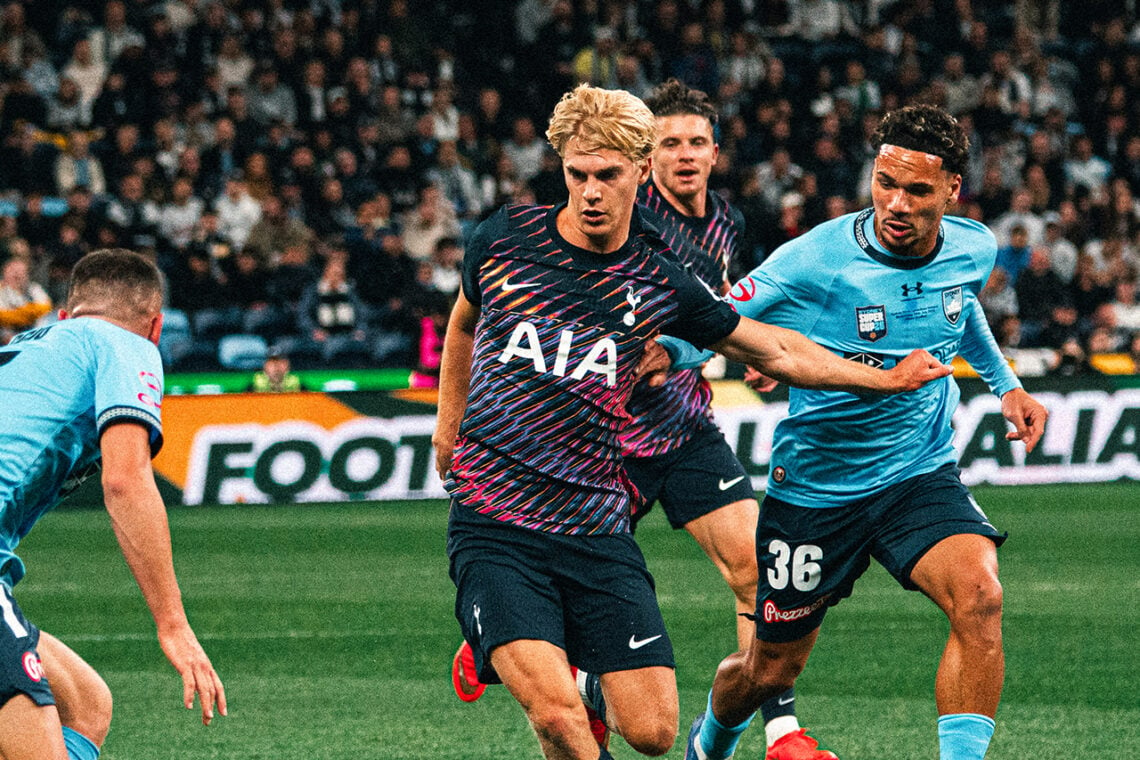


Spurs’ two consecutive wins against New Zealand’s Auckland FC and Australia’s Sydney FC already offer a precious glimpse into the way Tottenham Hotspur might play next season under Roberto De Zerbi.
When Roberto De Zerbi took over at Tottenham Hotspur, he made it incredibly clear that the kind of football he would coach to save Spurs from relegation would be a far cry from the kind of football he wants his teams to play.
To steer the club onto safer waters, Roberto De Zerbi kept his tactical instructions to a minimum, choosing instead to foster a sense of pride and unity in a dressing room devoid of confidence.
Now, this pre-season campaign will be crucial for De Zerbi to get his players used to his tactical demands so that the Tottenham Hotspur we might see during the 26/27 season is as close to the Italian’s vision as possible.
Let’s take a look at what kind of insight Spurs’ last two pre-season matches can give us into the kind of football they want to be playing.
Roberto De Zerbi ideas are starting to show at Tottenham
- De Zerbi continues to adjust his footballing ideas to make sure he succeeds at Tottenham.
Roberto De Zerbi came to fame during his time at Brighton and his approach of drawing in the opposition press to play through it quickly and access space in-behind. Conversely, when at Brighton and facing a team committed to, not pressing, staying deep in a low block, he struggled.
So, when he arrived at Olympique Marseille, De Zerbi’s previous job, the demands of the league (Marseille are one of the bigger teams in France) forced him to start developing a playstyle more suited to breaking down low blocks and other teams unwilling to press.
For example, one of the ideas he started using more frequently while at Marseille was a single pivot player to anchor his midfield. This allows his other two midfielders to take positions further up the pitch, creating more passing options in the half-spaces.
And while last season De Zerbi opted to exclusively set up with a double pivot for control and defensive solidity, when Spurs faced a defensively minded Auckland FC, De Zerbi opted to play Archie Gray in a single pivot role with two inverted fullbacks for support.
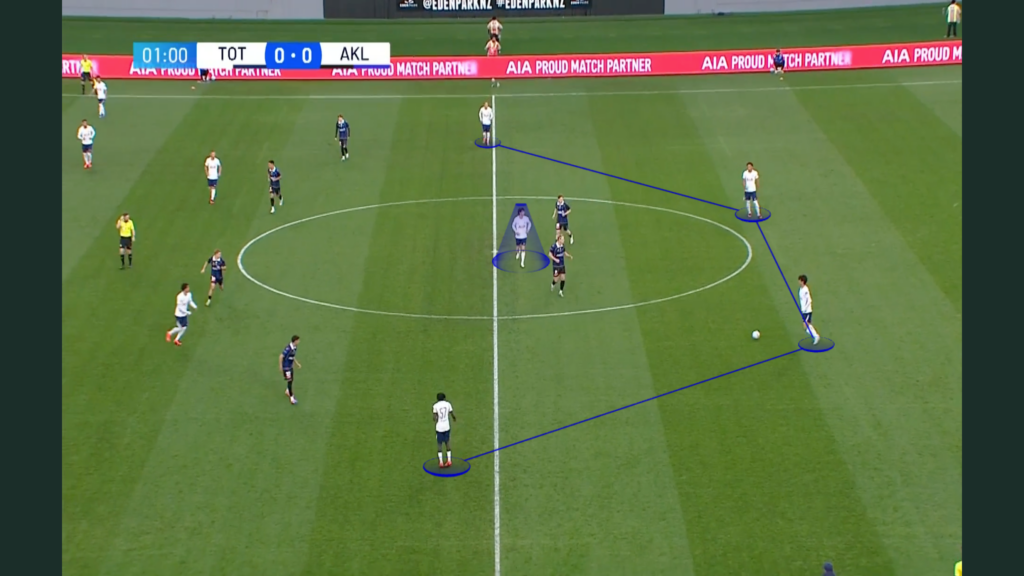
This gave Spurs settled possession in the middle third as well as quite a few options to find attacking players through combinations with the fullbacks.
Although a lack of experienced defensive players and a press that was still disjointed made this setup and Spurs very vulnerable to counterattacks, especially long passes down the flanks, we’ll likely see the single pivot and a more attacking-minded team more frequently next season.
- Roberto De Zerbi is also still staying true to his original footballing identity
Although it’s good to see Spurs have a tactical plan for defensive opposition, beating opposition presses is something that De Zerbi still wants his Spurs to be comfortable with.
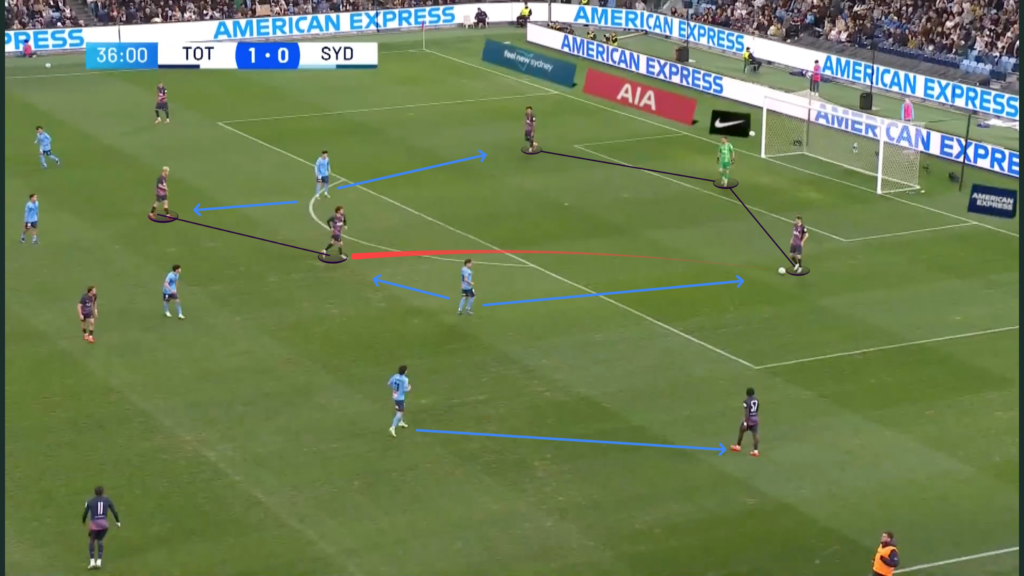
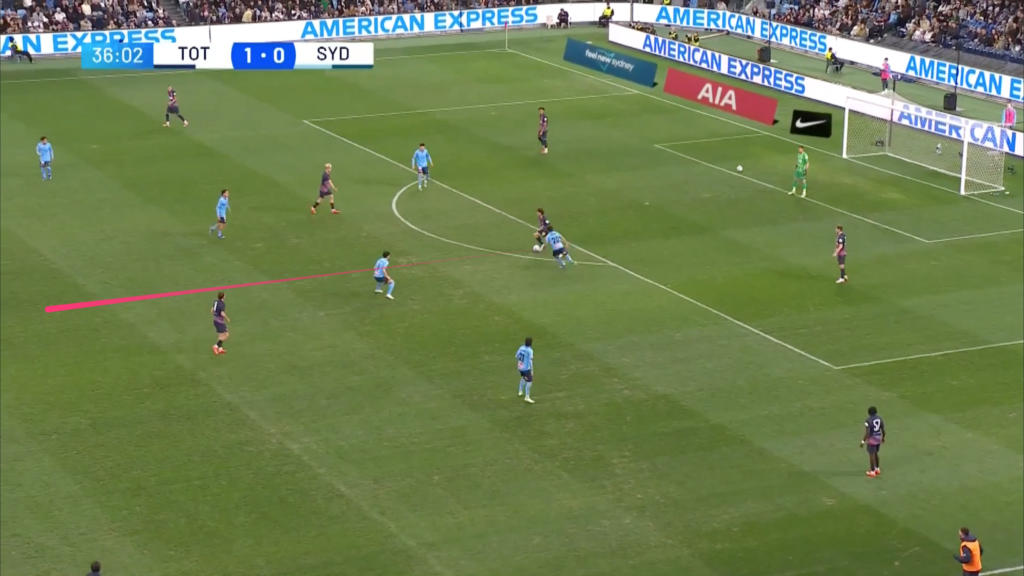
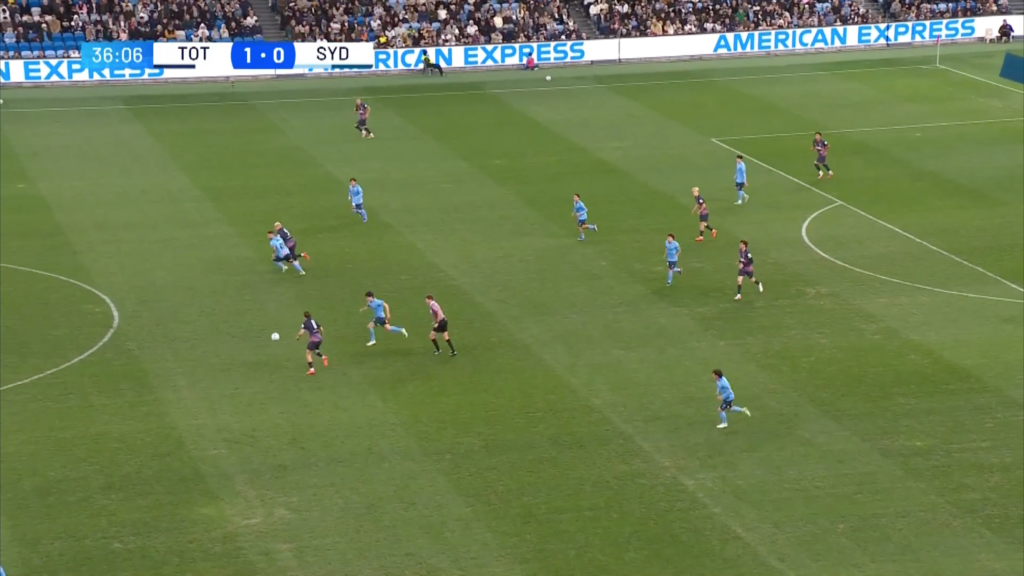
On the few occasions Tottenham managed to goad Sydney out of their defensive shape and into a high press, we saw the ideas that made De Zerbi famous.
His two centrebacks formed a situational back three with the keeper, Dubravka. With the fullbacks narrow and a double pivot of Bergvall and Gray, Spurs had a man advantage and forced the Sydney press into making difficult choices.
This set-up often managed to free up a Spurs player to receive a pass in-between the lines, giving Tottenham the chance to send their attackers running, like in this sequence here.
Spurs managed to consistently access attacking areas and create dangerous chances in both matches, a heartening fact given how weak Spurs’ creativity and attack were last season.
Of course, finishing those chances is an entirely different matter. With Maddison, Kudus, Solanke, Simons, and Odobert all still out, and with no attacking signings yet, Spurs’ current team is currently quite devoid of top finishers.
Despite comfortably creating opportunities for attack, the Tottenham players struggled to truly threaten in the six-yard box, making further attacking additions an obvious priority.
- A pivot player dropping into the backline highlights the flexibility and fluidity of De Zerbi’s setup.
Interestingly, what many assumed was Roberto De Zerbi’s attempt to platform Joao Palhinha by making him drop into the backline (thus covering up for his deficiencies in terms of passing and ball progression while allowing him to still excel as a pressing and tackling monster) is making a return in the pre-season.
During both of Tottenham’s last two matches, Roberto De Zerbi instructed one of his pivot players (usually Sandro Tonali) to also drop into the defensive line to try and pick the ball up from defence or to free up the fullback on that side to receive the ball inverted.
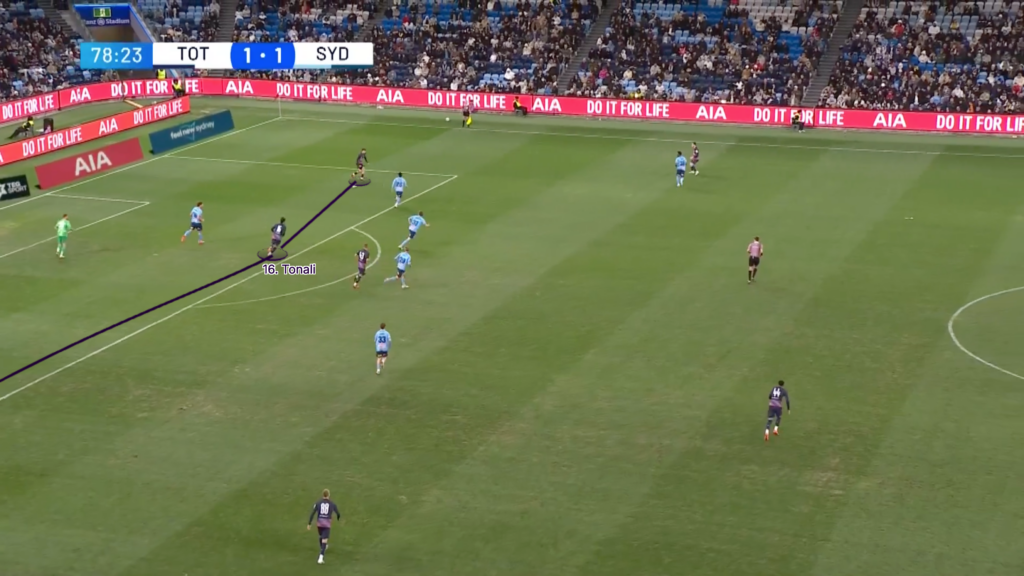
This is something that last season allowed Pedro Porro, then the only technical player with a quality pass at Tottenham’s disposal, to occupy more central midfield positions to ease Spurs’ progression issues.
With Tonali’s aptitude for carrying rather than progressive passing and an opportunity to put Pedro Porro in a scenario that suits him most, this is also something that De Zerbi is likely to implement heavily next season.