



As the curtains close on the absolute disaster that was the 2025/2026 domestic Tottenham Hotspur season, Jan Paul Van Hecke has emerged as a target to turn things around.
Spurs were quick to conclude that two free transfers that reportedly hinged on their Premier League survival, the signings of Bournemouth centre-back Marcos Senesi and Liverpool fullback Andy Robertson.
The board seem intent on keeping this frantic pace of signings going, looking to conclude a chunk of their business before the start of the World Cup. In the last few days, Spurs were linked to be in advanced talks with Manchester City for their winger Savinho.
Today, the world of Tottenham Hotspur woke up to another exciting bit of transfer news. David Ornstein, one of the most reliable transfer journalists, reported that Spurs are pursuing the signature of Brighton centre-back Jan Paul van Hecke, and the two sides are hard at work to agree terms for the defender’s signature.
Tottenham are now beginning to show their hand, as their three defensive additions form a pattern and indicate a clear philosophy behind their recruitment strategy.
But first, what can Tottenham expect from Jan Paul van Hecke?

What kind of player could Van Hecke be for Tottenham?
Van Hecke has been one of the mainstays of the Brighton defence and has been in the club since 2022, meaning he’s already had the opportunity to work with Roberto De Zerbi.
De Zerbi clearly favoured the Dutch defender, who featured prominently in Brighton’s starting lineups under De Zerbi and his successor Fabian Huerzeler.
When taking a closer look at the kind of defender that Van Hecke is, the metrics that stand out immediately aren’t his defensive attributes, but his exceptional ability with the ball.
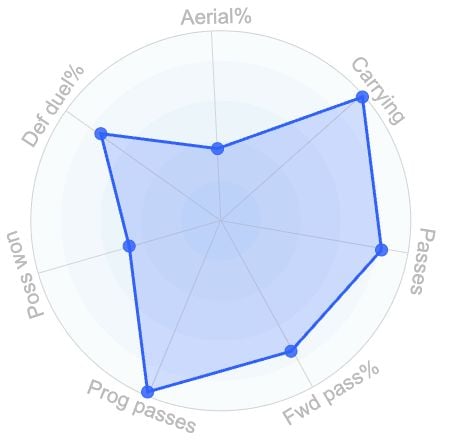
Even amongst other centre-backs, Van Hecke is amongst the most progressive passers in the league (passing backwards is quite difficult when you’re often the last man, and 7 out of 10 players with most progressive passes are centre-backs).
He ranks amongst the highest percentiles for progressive passes, the frequency with which he passes forward, as well as for his progressive carries. As far as Van Hecke goes, he is one of the most offensively and possession-minded centre-backs in the league.
It was his keenness to take risks with forward passes or go on adventurous runs with the ball that allowed Brighton to build the progressive football dynasty that they have become known for, both under De Zerbi and Huerzeler.
Van Hecke offers a fairly balanced defensive profile in general, being good in ground duelling, passing, and interceptions.
Supposedly, Van Hecke was close to the top of De Zerbi’s wish list when coming through the doors at Tottenham, as the club were linked with the defender during the season.
It’s likely that Van Hecke’s passing ability and progressive mindset are what had drawn De Zerbi to the centre-back again. The Italian manager clearly identified the lack of technical ability in the squad as a huge issue for Spurs, and an area he is most keen to improve in.
The centre-back topped the unfortunate chart of defensive mistakes leading to goals this season, tying his teammate, Bart Verbuggen. Van Hecke made 4 errors that resulted in opposition goals, although a part of that statistic can be accounted for by Brighton’s stalwart commitment to adventurous football playing out from the back, which carries its own risks, and De Zerbi could be willing to accept.
But it’s Van Hecke’s defensive attributes where the major caveats begin to appear. Of particular concern are his poor aerial record and relative lack of pace and athleticism. Van Hecke is not the most commanding presence in the box.
But this is also where we need to start looking at van Hecke in the broader context of the Tottenham squad and their recent recruitment, and how van Hecke’s characteristics could fit in alongside his potential centre-back partners.
How to build a Spurs centre-back partnership? And what does Van Hecke tell us about the current transfer strategy?
It seems like Tottenham’s centre-back policy is taking out entire pages from Oakland A’s Moneyball approach.
Cristian Romero has been heavily linked with a move away from Tottenham this summer. It seems like the squad is being prepared to handle Romero’s departure as best it can, particularly by trying to compensate for the technical ability he would take with him.
Comparing the general data between Cristian Romero (particularly his 24/25 season for Tottenham, given how radically different Thomas Frank’s team was to what can be expected under Roberto De Zerbi), shows how similarly van Hecke and Romero profile.
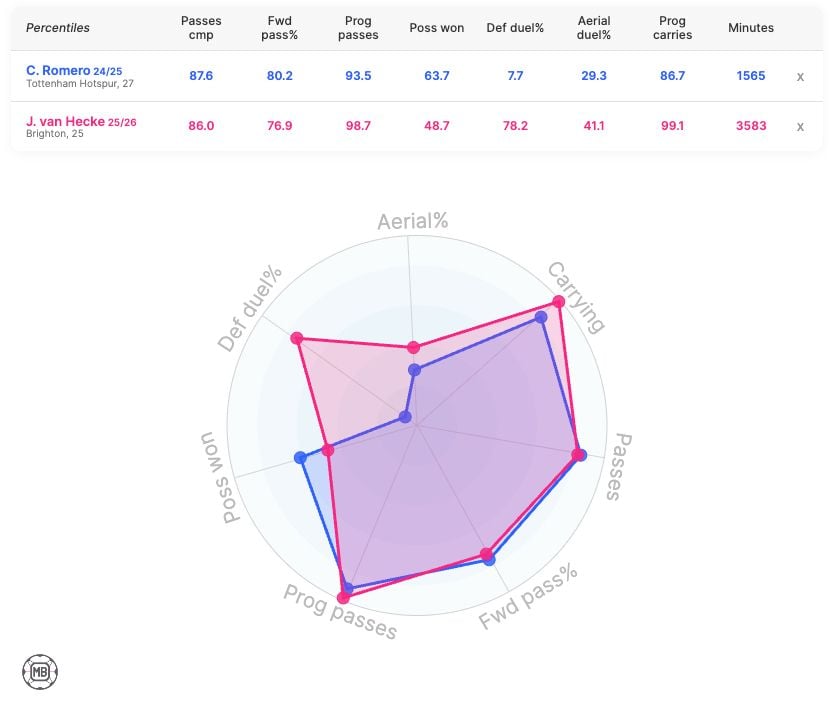
Similarly, Spurs signing another technically gifted centre-back in Marcos Senesi, give them another technical passer at the base of their formation.
This gives Tottenham the option to create two highly functional centre-back pairings where players’ strengths complement each other, while covering for weaknesses.
As we have established already, JP van Hecke is a centre-back with exceptional technical qualities that unfortunately lacks somewhat in his athletic profile and aerial abilities.
Van de Ven’s recovery speeds and his more reserved and patient style of defending will work exceptionally well with van Hecke’s aggressiveness in tackles and duels, as well as his passing skills (with the small caveat that neither van de Ven nor van Hecke are particularly good in the air).
Similarly, Kevin Danso’s strengths, his anticipation and aerial ability, would create a well-balanced partnership with Marcos Senesi, who profiles somewhat similarly to van Hecke.
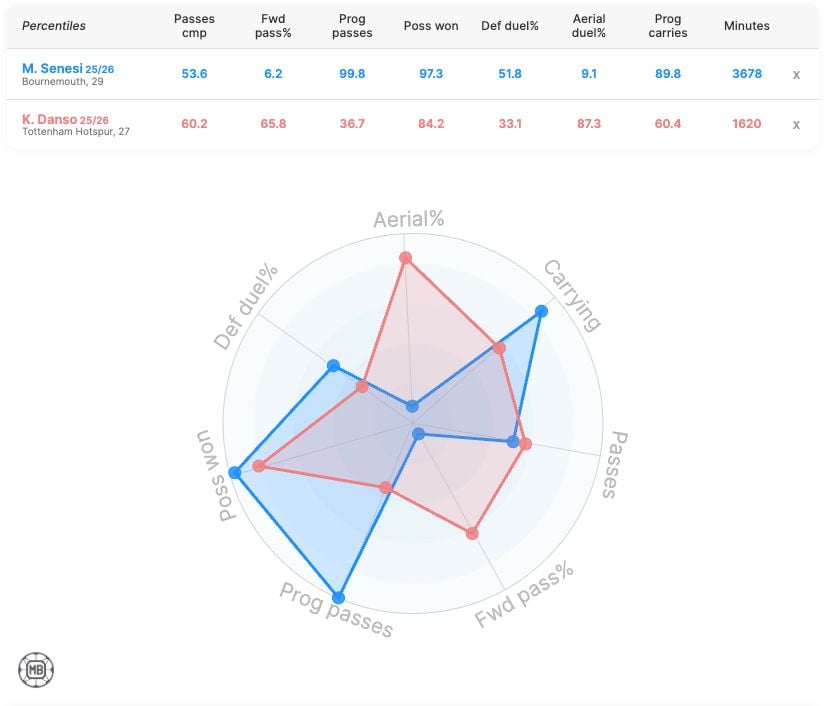
However, having an overreliance on your defensive partner to create a stable centre-back partnership creates its own problems, especially if those partners can only play on one side of the defence.
If at any point of the season De Zerbi chooses to rotate just one of his centre-backs, due to injury or otherwise, the pairing will find itself somewhat mismatched.
Spurs fans have already seen how limited in possession a pairing of Kevin Danso and Micky van de Ven was, while with Senesi at left centre-back and Jan Paul van Hecke on right, their athletic deficiencies would become too apparent and could easily be exploited during counterattacks.
It must be mentioned, of course, that centre-back partnerships are much more complex than a simple jigsaw puzzle. Defenders with opposing qualities aren’t guaranteed to make a good partnership and be a functional element of their teams’ defence.
Teams nowadays are smart enough to target and exploit the weaknesses of any one player, regardless of whether the player’s teammate cannot be targeted in the same way.
But if a team is correctly balanced, it is certainly easier for players to create solutions on the pitch, which can more readily mitigate the problems arising from individual weaknesses of players.
But if, a team as a larger unit, or in this case, a centre-back pairing, lacks athletic or technical qualities, those issues begin compounding on the pitch and give opposition teams easy decisions to make.
- READ MORE: Three realistic winger targets Tottenham should sign alongside Savinho, including Brighton star