
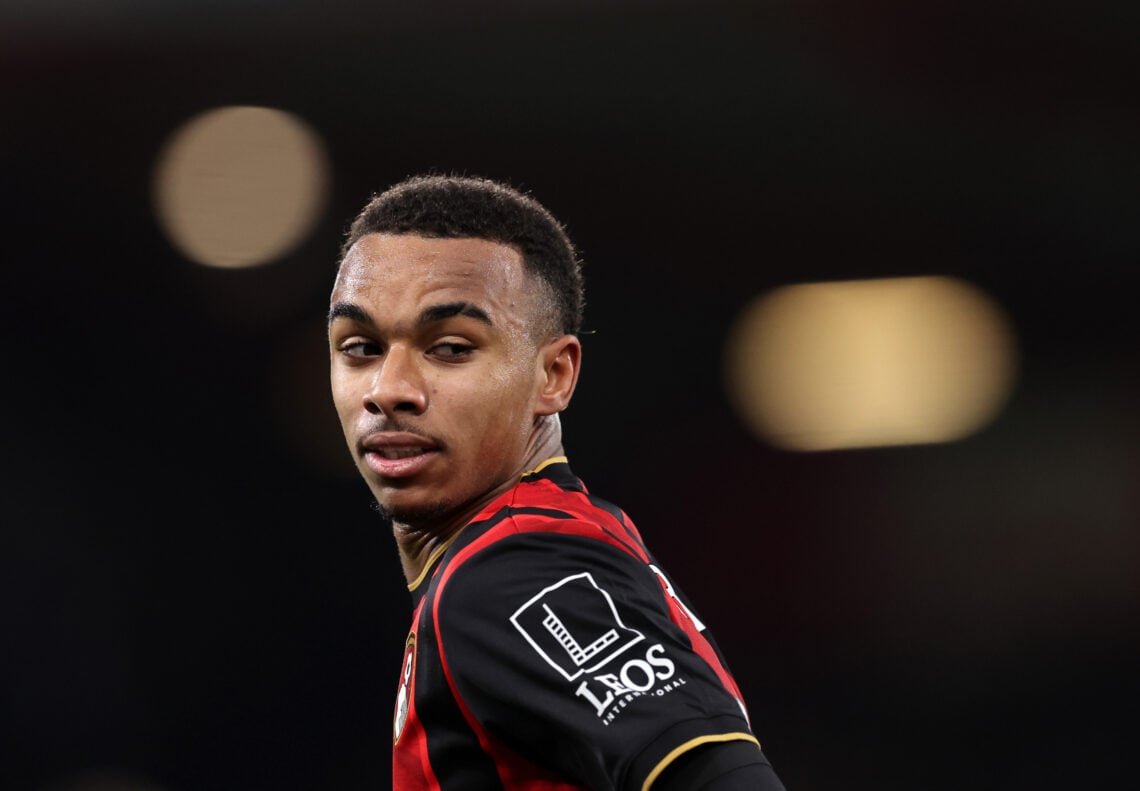


Over the course of the summer transfer window, Tottenham have been linked with various strikers, which seems to imply they are at least in the market for one. But what kind of striker does De Zerbi want and who, from the linked players, would be ideal for a De Zerbi system?
Tottenham Hotspur have undertaken the task of a summer rebuild of the proportions never before seen at the club.
They have not only smashed their all-time transfer record to bring in a new midfielder, they have done so twice in one day, signing Mateus Fernandes from West Ham and Sandro Tonali for an eye-watering combined fee of £185 million.
With their midfield business seemingly concluded, heads can now start turning towards the only position Spurs have not yet addressed, their attacking unit. With multiple additions to the front-three still expected this summer, it is now time to turn our attentions towards the changes we might see happen in Tottenham Hotspur’s striker role.
What kind of striker would Roberto De Zerbi even want at Tottenham?
Before we take a deep dive into Spurs’ striker business, let’s first try and get a grip on the kind of striker that might best fit a Roberto De Zerbi system.
As we’ve already covered, Roberto De Zerbi’s ideal game plan revolves around drawing in the opposition press and playing through that press with intricate passing and movement patterns to access the space in behind the opposition press.
While De Zerbi still wants his striker to function as an attacking focal point, especially when his teams are in possession higher up the pitch, he also wants his striker involved in the early phases of build-up.
We can take a look at how De Zerbi used his striker at his last club, Marseille, to see what we mean. Let’s strictly focus on the movement of De Zerbi’s forwards in the following pasage of play.
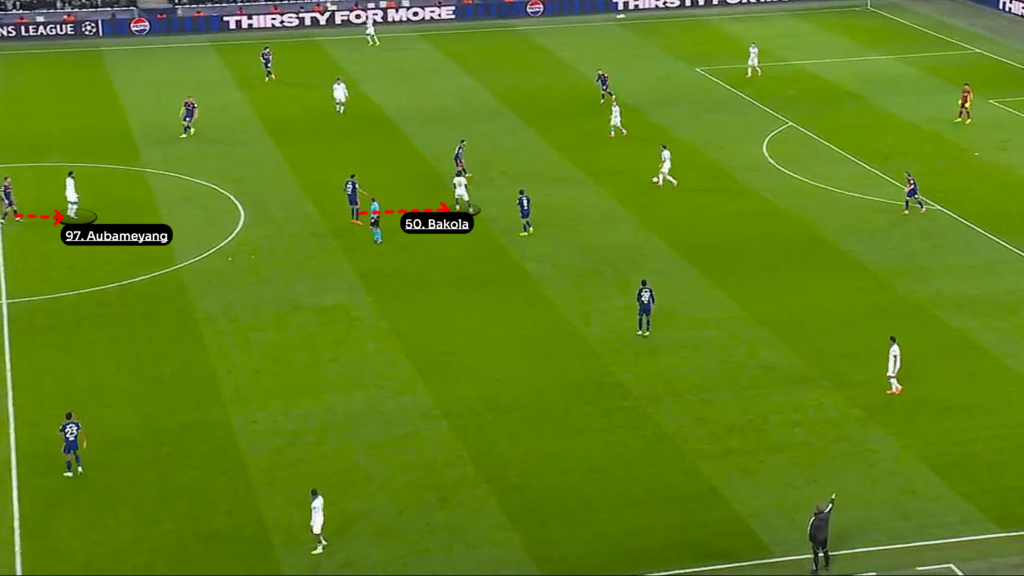
Here, Marseille are trying to play out against a hybrid marking system used by Newcastle in a Champions League game from last year.
Aubameyang was De Zerbi’s striker of choice for most of his time at Marseille and is currently staying up higher up the pitch, probably to serve as an option for a long ball. Aubameyang and the number 10. Bakola are both being man-marked by Newcastle, with Malick Thiaw on Bakola and Fabian Schär covering Aubameyang.
In an effort to upset Newcastle’s defending structure, Aubameyang decides to drop deep to provide an option and create space for Marseille’s buildup on their left side.
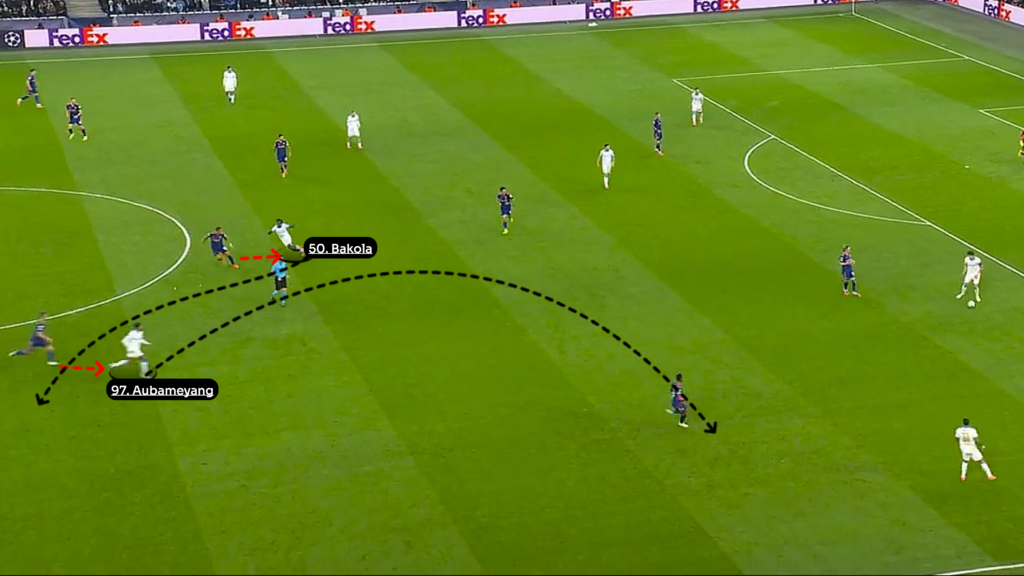
Bakola knows he needs to cover the space Aubameyang is leaving, and jumps into the advanced position, dragging Malik Thiaw with him.
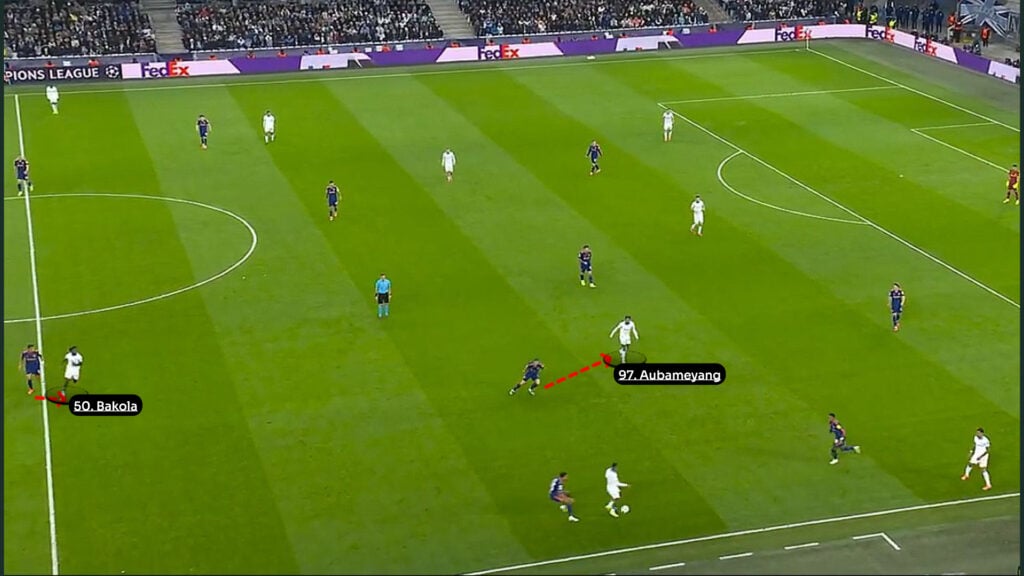
Aubameyang’s run pulls away Fabian Schär from the backline, and the striker is now available to combine with his teammate.
Strikers in a Roberto De Zerbi system are expected to make these kinds of runs multiple times per game as they come part and parcel with De Zerbi’s football and are a big part of his training.
The purpose of such runs is, of course, to create spaces and upset opposition defensive structures, and to excel in that role, a De Zerbi striker must be technically gifted and comfortable in both passing and receiving, on top of an ability to play as the target man in the box.
Putting Tottenham’s striker links in a broader context
Now that we have a better understanding of the role De Zerbi might want his striker to play, we can start looking at the current situation at Spurs.
The 2025/2026 season shows how dire Tottenham’s need is to upgrade on their available strikers.
Richarlison’s willingness to consistently duel for the ball has inspired a few results this season that may have kept Spurs in the league. But Richarlison has also visibly declined in terms of his athleticism and is held back by a low technical level, making him unfit to also play deeper in a De Zerbi system.
As his injury record has improved massively since the 24/25 season while putting up an altogether decent tally of 11 goals and 4 assists in the Premier League, it might be the optimal time for Spurs to recoup some of the transfer fee they paid for Richarlison in 2022.
It’s also safe to say that since arriving at Spurs from Bournemouth, Dominic Solanke never truly got going. Solanke struggled with injuries ever since he arrived at Tottenham, but a few good spells under Ange Postecoglou and his outstanding ability to link play as a centre-forward could justify giving the ex-Cherry more time in a stable environment under Roberto De Zerbi.
Regardless of that, Solanke’s unreliable availability means he probably shouldn’t start next season as Tottenham’s only true striker option, leaving us with a squad need that has to be filled by a new signing.
Spurs seem to have entered the summer transfer window cognisant of the need to sign a striker, with the club consistently linked to different names since the window’s opening, so what are these names, and what profile do they generally fit?
Who have Spurs actually been linked with?
- Moise Kean
Fiorentina’s Moise Kean was one of the earliest links of the summer, perhaps explained by a Spurs-ex, Fabio Paratici, who took over the sporting director role at the club after the January transfer window.
Moise Kean managed to perform to a high level in a Fiorentina team that also endured an incredibly challenging season, and despite a patchy injury record, ended the season with 8 goals and 1 assist.
Kean is an absolute outlier in the traditional striker metrics, ranking in the top percentiles for goals, shots, headed goals and the various xG statistics. His conversion rate leaves a bit to be desired but should be caveated with Fiorentina’s performance issues last season.

But Moise Kean’s in-possession game is where his flaws become concerning, as he pretty much exclusively functions as a target man, a profile Spurs already have in Richarlison.
- Omar Marmoush
Manchester City’s Omar Marmoush is an interesting player profile and is said to be admired by Roberto De Zerbi. Marmoush played a big part for City in the 24/25 season, but his chances to make an impact this year were limited, and the Egyptian played a pretty poor season.
At first glance his passing statistics could be a dealbreaker for De Zerbi, but thats largely to do with the role he was asked to play for Pep Guardiola this season.
| Marmoush 25/26 passing | per 90 | Percentile |
| Passes | 20.89 | 12th |
| Successful Passes | 18.31 | 18th |
During his time at Frankfurt and the second half of the 24/25 season at City, Marmoush was allowed more freedom and given more consistent minutes, leading to improved performances in both his goal output and link-up play.
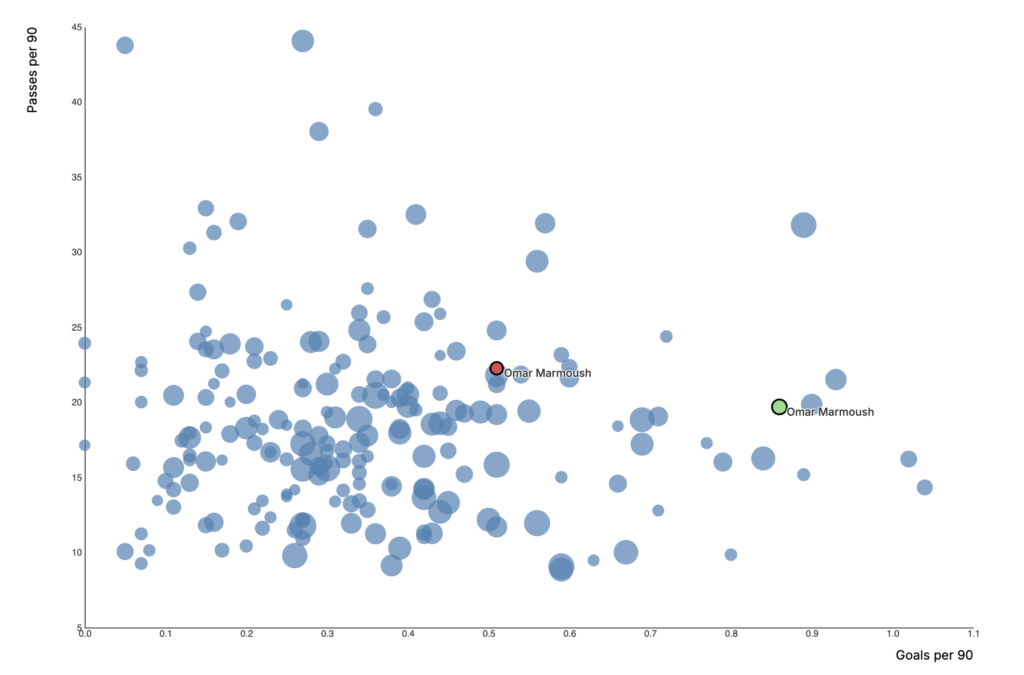
Having a big-time role at Tottenham could be appealing for Marmoush, but City are known to be unwilling to part with their players, so a deal could be difficult.
Regardless, Marmoush offers a very well-balanced profile and is capable of both dropping deep and playing as a target man.
- Falorin Balogun
Links to the USMNT striker and Arsenal academy product are one of the more recent ones, which seem to have emerged as a consequence of the forward playing a particularly good World Cup.
Profile-wise, Balogun is definitely closer to a traditional poacher and target man, frequently ending up taking touches in the penalty box while being less involved in buildup and linking play. He would, in theory, be a valuable option for De Zerbi as almost an inverse profile of Dominic Solanke.
But a De Zerbi striker has so far been expected to play both as a poacher and as a creator, with Balogun excelling at one but being rather poor in the other.
- Eli Kroupi Jr.
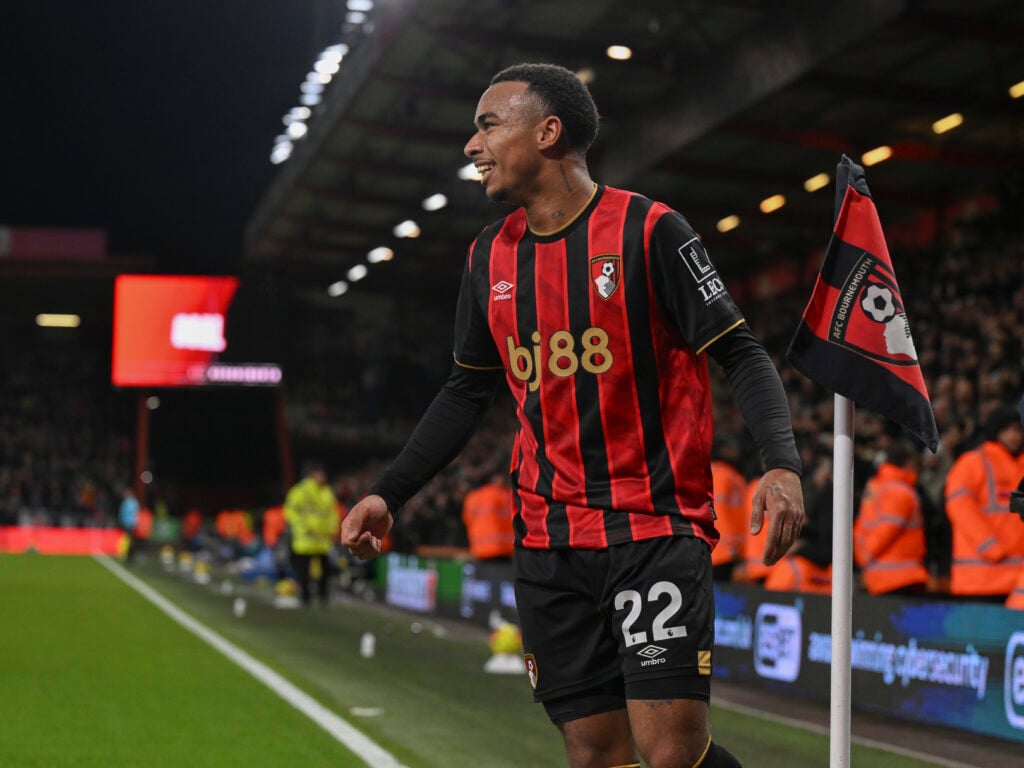
Kroupi Jr. is definitely one of the more fairy-tale transfer targets. After a truly breakout season for Bournemouth, Kroupi has been said to be on the radar of the biggest clubs in Europe, like PSG. Arsenal have also reportedly enquired about the striker’s availability.
But after recent links emerged between Tottenham, who are willing to meet Bournemouth’s valuation, and Kroupi, who is reportedly interested in the Roberto De Zerbi-led project, there is now a non-zero chance that he’ll play in Lilywhite next season.
As a striker Kroupi functions somewhere in the grey zone between a false nine, a mobile shadow striker, an inside left wing option and a number 10, making him an incredibly versatile player.

He’s one of the world’s top technical talents, excelling in ball-striking and generating separation as well as linking play.
Even when considering his tactical fit for a Roberto De Zerbi system, he stands out as an outlier both for his passing and finishing.
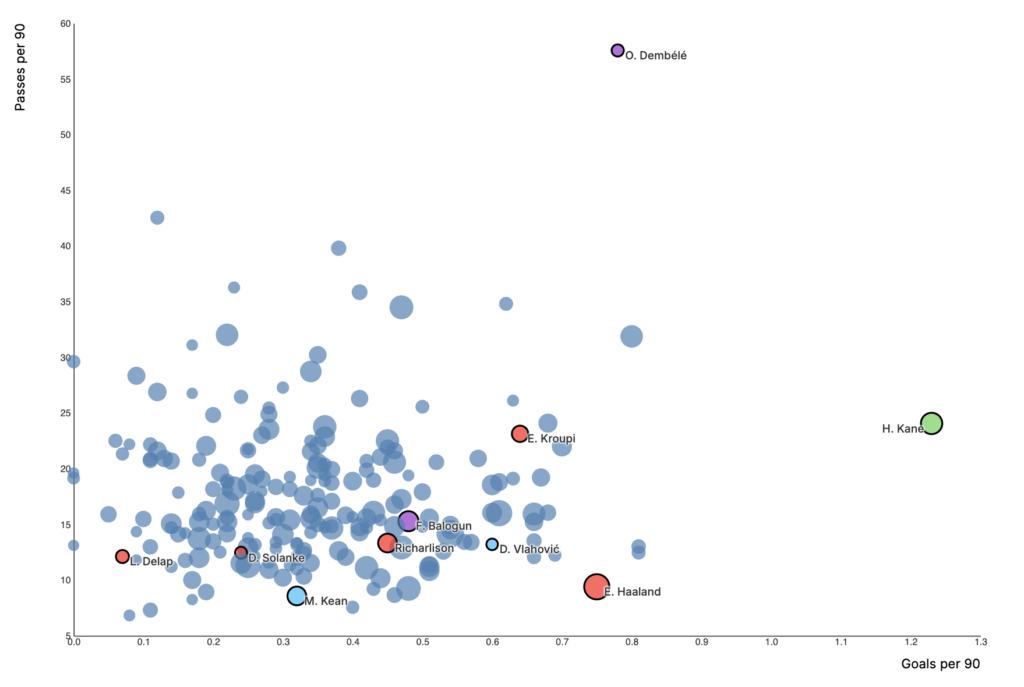
Frankly, there is no world in which signing Kroupi Jr. is a misallocation of resources, because at 20 and with his peak still years ahead of him, he has the potential to be counted among the best attackers in the world.
- READ MORE: The most unlikely Tottenham turnaround in history was born out of a Metropolitano disaster