



After almost 18 months of being sidelined through a complicated injury, Tottenham have finally confirmed that Dejan Kulusevski is back doing outdoor training.
Besides “I always win things in my second season,” “It’s just a knock” stands as one of the most iconic quotes from the Ange Postecoglou tenure.
After being forced off the field against Crystal Palace in the closing stages of the 2024/2025 season, Dejan Kulusevski was meant to be back available almost immediately.
18 months, two surgeries and four managers later, we have finally seen footage of Dejan Kulusevski playing football again. If the Swede really is approaching full fitness, as per the club and Roberto De Zerbi, he could be an invaluable attacking option in the coming season.
But, with how much time passed since Kulusevski last played a match in a Tottenham shirt, all of us probably stand to benefit from a refresh on the player Kulusevski used to be.
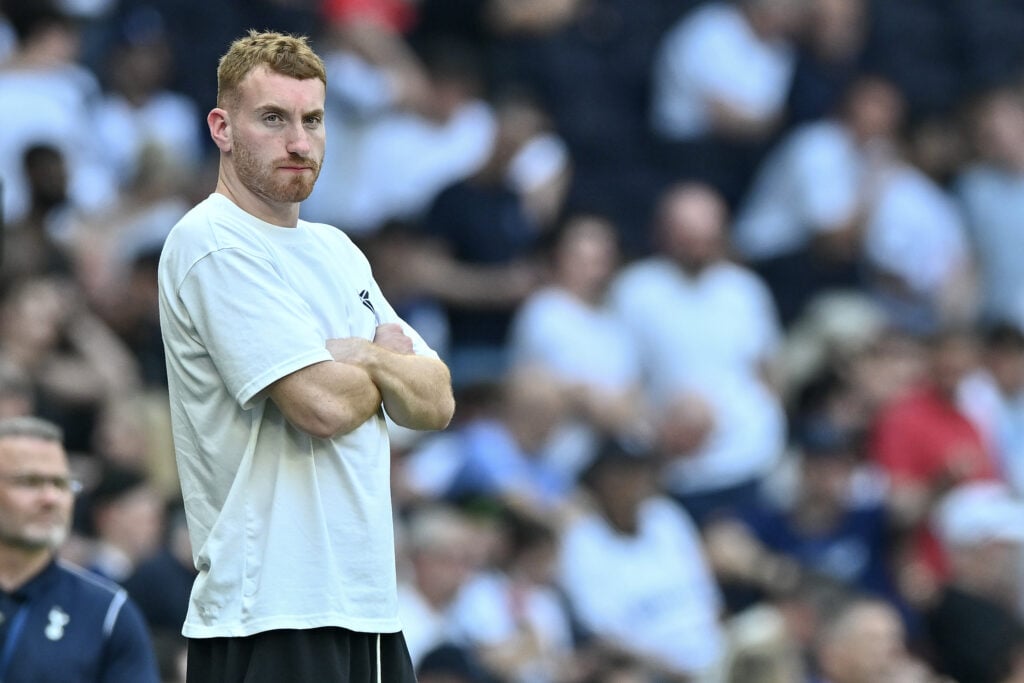
Will Dejan Kulusevski be the same player at Tottenham?
Before his injury, Kulusevski was one of the best big-space midfielders in the Premier League. His best qualities – his ball-carrying, his technicality, ball striking and being absolutely relentless in his running – allowed him to thrive under all of the managers he played under.
Kulusevski played as an inside forward for Antonio Conte and even though at first he was misprofiled somewhat when made to play as a touchline winger for Postecoglou (despite his physicality and technicality, taking on a defender was never Kulusevski’s forte), the Greek quickly moved him into midfield as an attacking 10.
Kulusevski seemed to have found his stride as the most advanced midfielder under Postecoglou. James Maddison’s patchy injury record allowed Kulusevski to feature quite prominently in the 24/25 season, either as the starting 10 or sometimes in a midfield pairing with Maddison in a double 10 set-up, true to Postecoglou’s all-out attack philosophy.
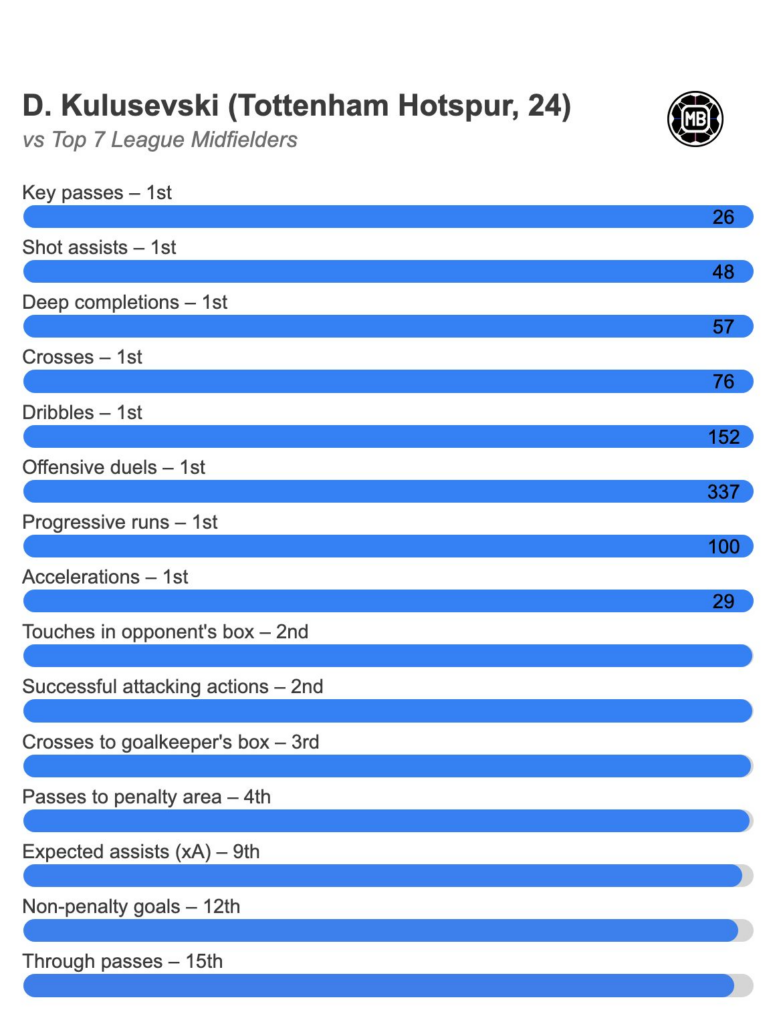
His midfield performances in the 24/25 season had Kulusevski in the top percentiles for almost all meaningful midfield statistics last year, and had he remained fit, he surely would have remained as a key player at Tottenham.
Alas, his injury at Crystal Palace put his development as a player to a screeching halt. Kulusevski suffered a broken patella and a torn patellar tendon, a combo of injuries that are incredibly difficult to manage when occurring together.
His prolonged absence and the complexity of his injury, requiring two separate surgeries almost a year apart, mean that it’s unclear what other kind of consequences the injury may have carried.
Rumours around the club seem to believe that Kulusevski lost a bit of his pace and physicality, and as those used to be qualities he relied on to excel as a player, whether the Kulusevski we hopefully see next season is the same world-beater that he used to be or if he’ll ever reach his earlier highs is under a massive question mark.
Of course, the fact that he’s back in training should be a positive sign and could signal that Kulusevski still has De Zerbi’s faith and a future at Tottenham.
So, while keeping the caveats of his injury in mind, how could De Zerbi use Kulusevski in his system?
What would Kulusevski’s role look like in De Zerbi’s system?
We broke down what De Zerbi wants from his attacking players in a few articles before (check them out here or here), but in a nutshell, the Italian’s game model is largely about creating space to run at for his attacking players, particularly his wingers.
The post-injury Kulusevski might struggle to do the running necessary to play a winger role for De Zerbi, and, since the wingers in that set-up are often required to hold width, they may end up becoming isolated.
As a winger, Kulusevski’s associative play and ball progression would be stifled, so his future almost certainly doesn’t lie on the wings.
Instead, De Zerbi might be tempted to use Kulusevski as another option in the 10 position, one that offers something distinctly different to either James Maddison or Conor Gallagher (or to the currently injured Xavi Simons).
Kulusevski is less of a lockpicker than James Maddison, who prefers having time on the ball and working in tight spaces. Instead, the Swede is incredibly well-suited to playing against aggressive teams, ones that use man-to-man marking systems, which give Kulusevski the chance to beat his marker and go on runs centrally.
In one of his most famous performances for Spurs, the 0-4 win away at Manchester City (spawning the nickname “Dekihad”), Kulusevski consistently created dangerous situations for Spurs with his central runs with the ball.
His rapid movement and close ball control, Kulusevski could serve as an option to relieve pressure with his runs, all the while his technicality and intelligence make him well-suited to playing the quick passes that De Zerbi might expect.
Whether he’s still capable of that remains to be seen.